Resolve bottlenecks. Prioritise measures. Keep the business able to act.
Under pressure, many tasks compete for the same time and resources. We help distinguish immediate needs from structural problems and establish a realistic sequence of action.
AI-generated illustration · not a photograph of a client engagement
Establish what needs attention first.
We start with current cash availability, obligations falling due and earnings. We review available figures and clarify which decisions cannot wait. Missing or uncertain information is explicitly identified.
In parallel, we examine operations: Where does material flow stall? Which orders or products weaken earnings? Which capacity and skills does the business actually need?
Not every saving benefits the business.
A cost reduction may put quality, delivery capability or revenue at risk elsewhere. We therefore assess measures in context: What effect is expected, what expenditure comes first and when is cash released?
We rank projects by urgency, impact and feasibility. Existing departmental ideas are assessed alongside newly developed proposals.
Make implementation accountable.
Each priority measure has an owner, next steps and reviewable dates. Regular discussions focus on actual progress: What has been implemented? What blocks the next step? Which decision is needed?
Effects are tracked in the plan. An agreed measure is not treated as an improvement already achieved.
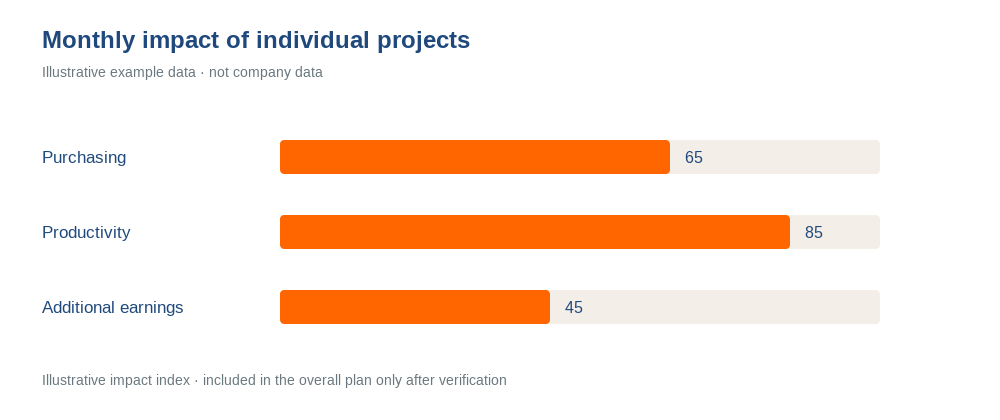
Make project impacts traceable
Illustrative example: planned improvements are considered separately and incorporated into the overall plan after verification.
A shared basis for owners and banks.
We present the starting point, measures and expected development so stakeholders can assess the same assumptions. Deviations and new findings are made explicit, keeping decisions grounded in the current situation.
The food industry case study illustrates how operating changes can contribute to an investor proposition.
Restructuring reports and StaRUG support.
Restructuring reports under the German IDW S 6 standard and business and financial support on matters relating to Germany’s Corporate Stabilisation and Restructuring Act (StaRUG) are an integral part of our services. We work with experienced lawyers to provide legal support.
When additional executive responsibility is needed.
If implementation requires a temporary managing director, we agree an appropriate interim assignment with you. Where needed, this includes managing director roles during German self-administration insolvency proceedings and introductions to experienced lawyers for legal support.
What needs resolving first in your situation?
Tell me about the most urgent bottlenecks and the figures available. We can then establish a useful starting point and the scope of support required.