Integrated business planning for mid-sized businesses
How company data becomes a reliable basis for decisions.
Our proprietary planning cockpit takes Excel-based planning forward as a web application and a standalone version. This page explains the inputs, responsibilities and practical use of its reports.
AI-generated illustration · not a photograph of a client engagement
From historical performance to a baseline plan.
BFDM prepares a projection using past trial balances, taking account of seasonal patterns and exceptional items. It provides a starting point for assessing how the business might develop under the selected assumptions; it is reviewed rather than treated as a prediction.
Together with your specialists, we assess those assumptions and develop the baseline plan. The historical projection and the agreed baseline provide reference points for evaluating proposed changes.
Data sources and mapping.
Trial balances supply the financial starting figures; personnel records provide the basis for workforce planning. The chart of accounts maps this data to planning positions. With your specialists, we add operating assumptions, such as revenue development and staffing needs.
A figure must be traceable to its source or assumption. When circumstances change, this makes it possible to identify which parts of the plan need updating.
Why earnings, cash flow and the balance sheet belong together.
A profitable order may require materials and labour before the customer pays. An investment affects cash requirements at a different time from earnings. An integrated view helps assess these different effects together.
Reports therefore cover not just expected earnings but also cash flow, financial planning and balance sheet development.
Keep each project’s contribution identifiable.
Each project is broken down into tasks with durations, dependencies, owners and milestones. Expenditure, expected savings or additional earnings are planned separately. An effect can be linked to completion of a particular task, including a delay or a ramp-up period. Reviewed projects are included in the business plan when selected for incorporation.
The company records actual dates, costs, returns and progress. These updates help assess completion forecasts and the timing of financial effects. Recorded project actuals can replace planned values up to the reporting date in months after the latest trial balance, making the link to earnings, financial planning and the balance sheet explicit.
Who does what in the system.
Consulting: We develop the initial plan with your specialists and record agreed projects. The underlying assumptions are agreed with the company.
Project administration: The project administrator enters actual dates, costs and returns, together with progress reports.
Company management: Managers use reports and the project cockpit in presentation mode. Project managers can enter actual dates, costs, returns and progress reports without viewing accounts, trial balances or salary data. Access is assigned by role for each company; responsibilities are agreed during the engagement.
The monthly working cycle.
New trial balances and project actuals establish the current position. We compare performance with the plan, discuss material deviations and review whether assumptions or project effects need adjusting.
Multi-year planning builds on the same foundation, connecting short-term decisions with the longer-term outlook.
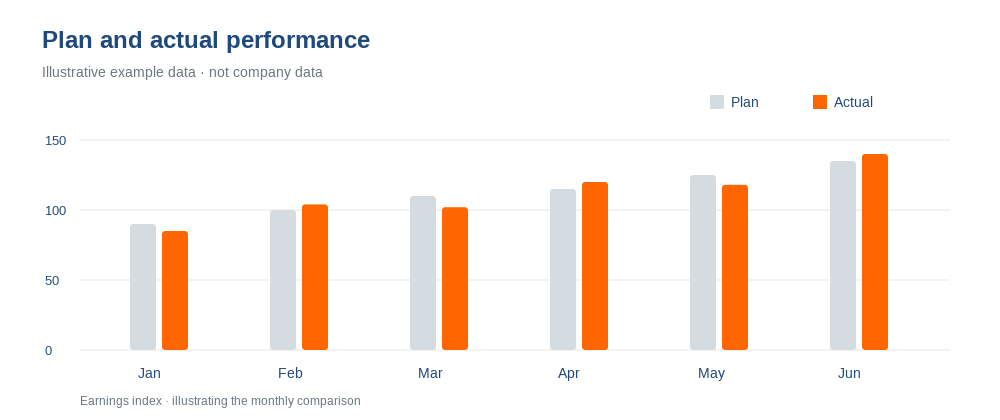
Keep plans and actual performance in view
Illustrative monthly comparison using sample figures. This explains the approach and contains no company data.
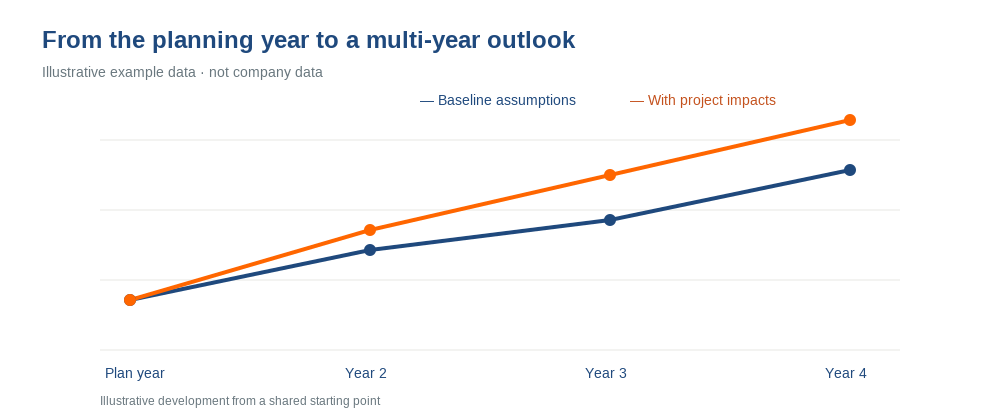
A multi-year outlook on the same basis
Illustrative sample figures · no company data and no promise of results.
Appraise investments and optionally include them in the plan.
The linked investment appraisal supports the financial assessment of proposed investments. If required, an investment can be incorporated into the business plan, allowing its implications to be considered alongside ongoing operations and improvement projects.
A loan calculator is also available to calculate and assess financing options alongside the investment decision.
Separate project management for operational detail.
The system also provides access to a separate project management application. Schedules, milestones, dependencies, critical paths and resource overviews support the organisation of implementation.
The project planning within the planning cockpit records the projects’ financial effects and links them to the business plan. The separate project management application provides an additional workspace for detailed operational coordination.
Present the plan and continue after the engagement.
Presentation mode helps explain business development and project progress; printable calculations complement charts for detailed review.
After the engagement, your company can continue using the plan with its own data indefinitely, without further charges for the planning system. Choose the online application at planung.bfdm.eu or the standalone version. Data and assumptions still need to be maintained.
A clear view of the business
For decisions. And shared understanding.
Business performance at a glance. Presentation mode brings plans and actual performance together for discussion.Illustrative view based on the original layout · fictional sample figures · no client data or promise of results.
What planning do you already have?
Discuss with me which data is available and how you want to use the plan. This helps establish the work involved in setting it up and maintaining it.